
DMZ #2
In which your correspondent enters the demilitarized zone proper and encounters fog, axe murders, and Americans

[LINK TO PART 1 AT THE BOTTOM OF THE POST]
When my alarm went off this morning I felt nervous – I never feel nervous – and I have been questioning what I am doing here ever since. The cat café would have made for a more relaxing day off.
But now Imjingak Resort has made me worry about my motivations for coming here too. I told myself I was coming as a respectful visitor – to learn more about Korea’s past, about the world, about one of the planet’s most enduring, seemingly intractable conflicts – but maybe I’m just gawking at other people’s misery.
Still, is it better to be back in hyperactive Seoul, just 50km from the DMZ, theoretically at risk of missile attack from the North at any given moment, and to be completely oblivious to all of this??
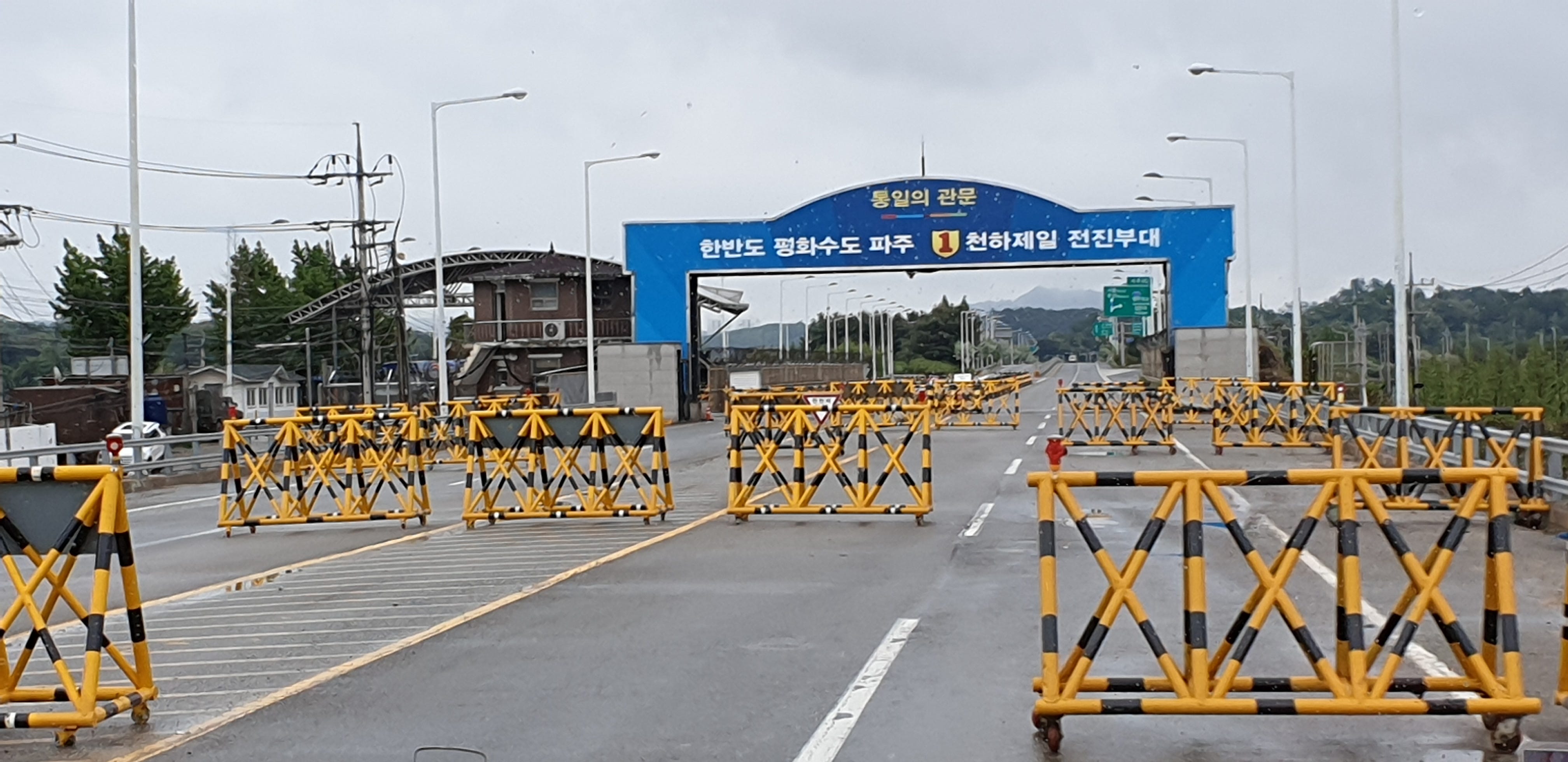
The official bus is the only way a civilian can enter the DMZ proper. On board, everything starts to feel more real as we slalom through dozens of yellow and black barriers scattered across the road before being waved through an armed checkpoint. Chance used to man these same checkpoints as a young man. He tells me the barriers aren’t designed to stop anyone from passing through, just to slow them down for long enough to be shot.
Our itinerary is out of our hands now and we visit a series of eccentric places, in that register unique to the DMZ, straddling the mundane and the epoch-defining.
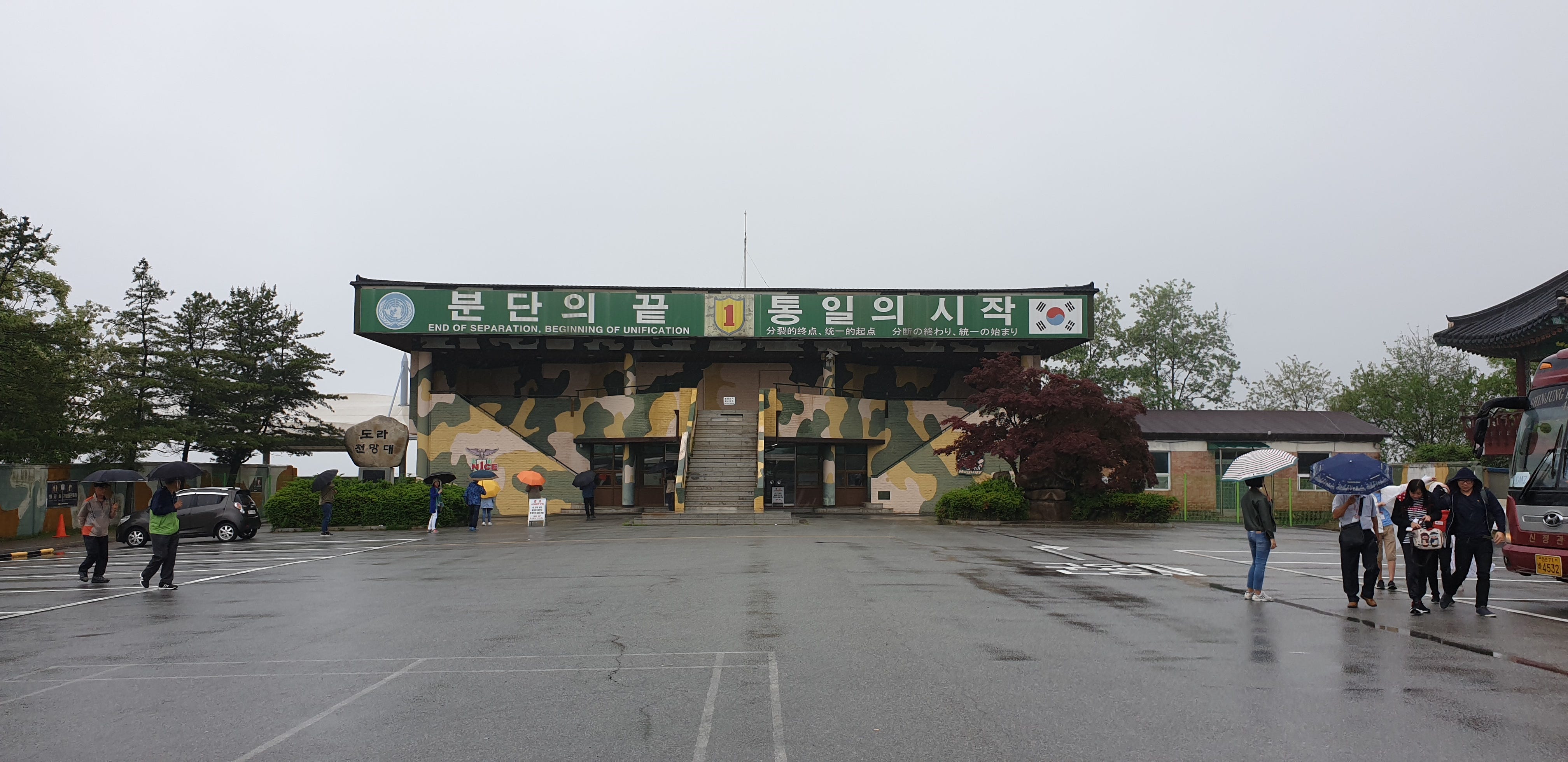
There is the tall Dora Observatory, its exterior painted in green, yellow and beige camouflage dapples, as if it could ever be disguised from view, a large slogan on the roof reading End of Separation, Beginning of Unification. Inside there is a small lecture theatre which people sit down in automatically, awaiting an address that never comes. We are promised that up on the observation deck you can see over the border into North Korea, the most isolated, secretive dictatorship left anywhere on the planet.
I have been reading about Kijong-dong, a small settlement just over the border – it is known as the Peace Village in the North, and the Propaganda Village in the South. By all accounts, the architecture of this small town, built in the 1950s with its bright white walls and bright blue roofs, is the best-maintained of anywhere in the North. The buildings are said to look pristine from a distance but, when observed more closely, they are just façades. There is no glass in any of the windows.
The whole village is an elaborate performance piece designed just for those of us looking in across the border – beautiful families with perfectly-behaved children are bussed in to the town every day, solely for the purpose of being observed.
Up and out on the viewing deck of the Observatory, there are rows of silver telescopes, just like any other tourist resort, waiting for us to use them. To peek into the North with arched eyebrows. Performance facilitated by both sides.
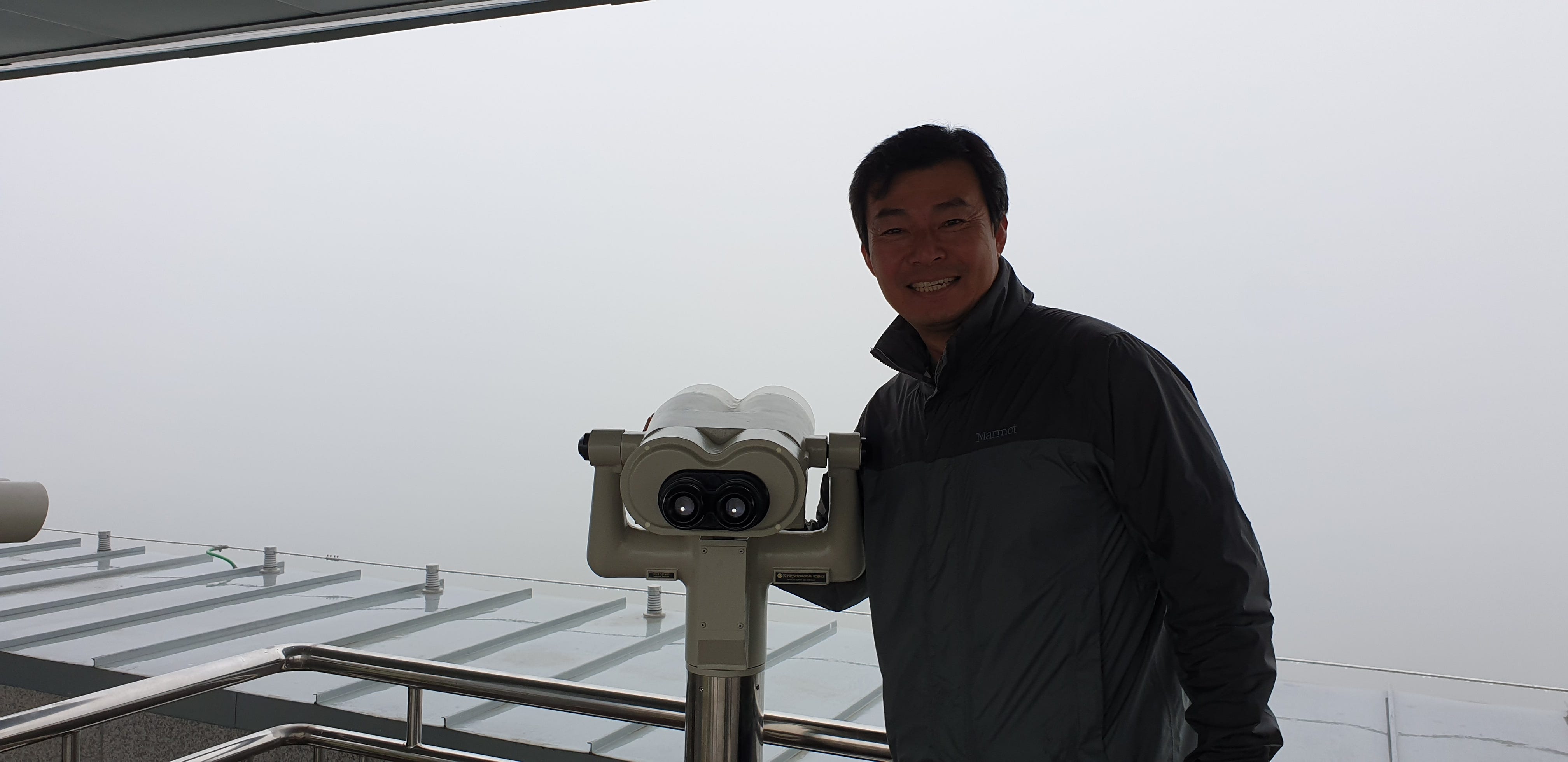
But when Chance and I get up there the morning fog is thicker than syrup. If you stretch out an arm, your own hand disappears somewhere else entirely. We take pictures of each other posing next to the telescopes with big grins on our faces. When we look down at the photos, it’s like we’re standing next to a prop in a photographic studio, a heavy grey curtain just behind us. Today’s recital of the propaganda village will remain unobserved.
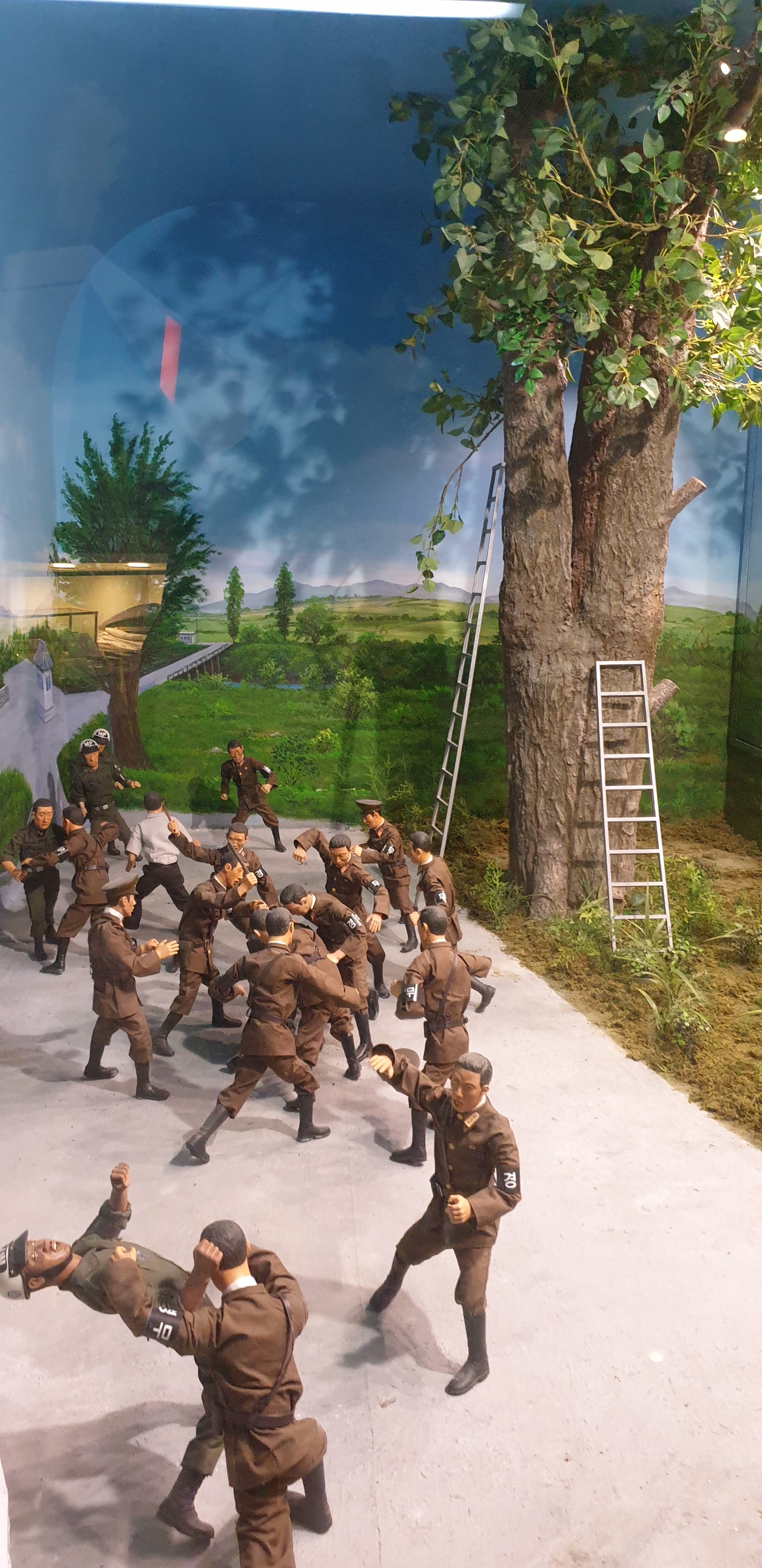
There is still the small museum explaining the history of the DMZ to visitors like me. It consists mainly of small replica landscapes (so much carefully-cut astroturf, so many angry plastic men) and enigmatic captions – The poplar stump of the Panmunjom axe murder incident – which require extra-curricular googling to be deciphered.
And of course, inevitably, there is also the fifteen-minute stop scheduled at the official DMZ souvenir shop. It sells unappealing-looking rice sweets from the North, and long bottles of Sprite, and t-shirts in primary colours with DMZ emblazoned across the front like a designer logo. It’s difficult to imagine the social occasion where they would make sense.
Chance – who has done this journey a hundred times before – stays on the bus. As our fellow travellers queue up in the shop, I wander around in the open air outside, a sweeping green landscape dotted with houses, some painted in sand and khaki camouflage patterns which make them pop against the trees.
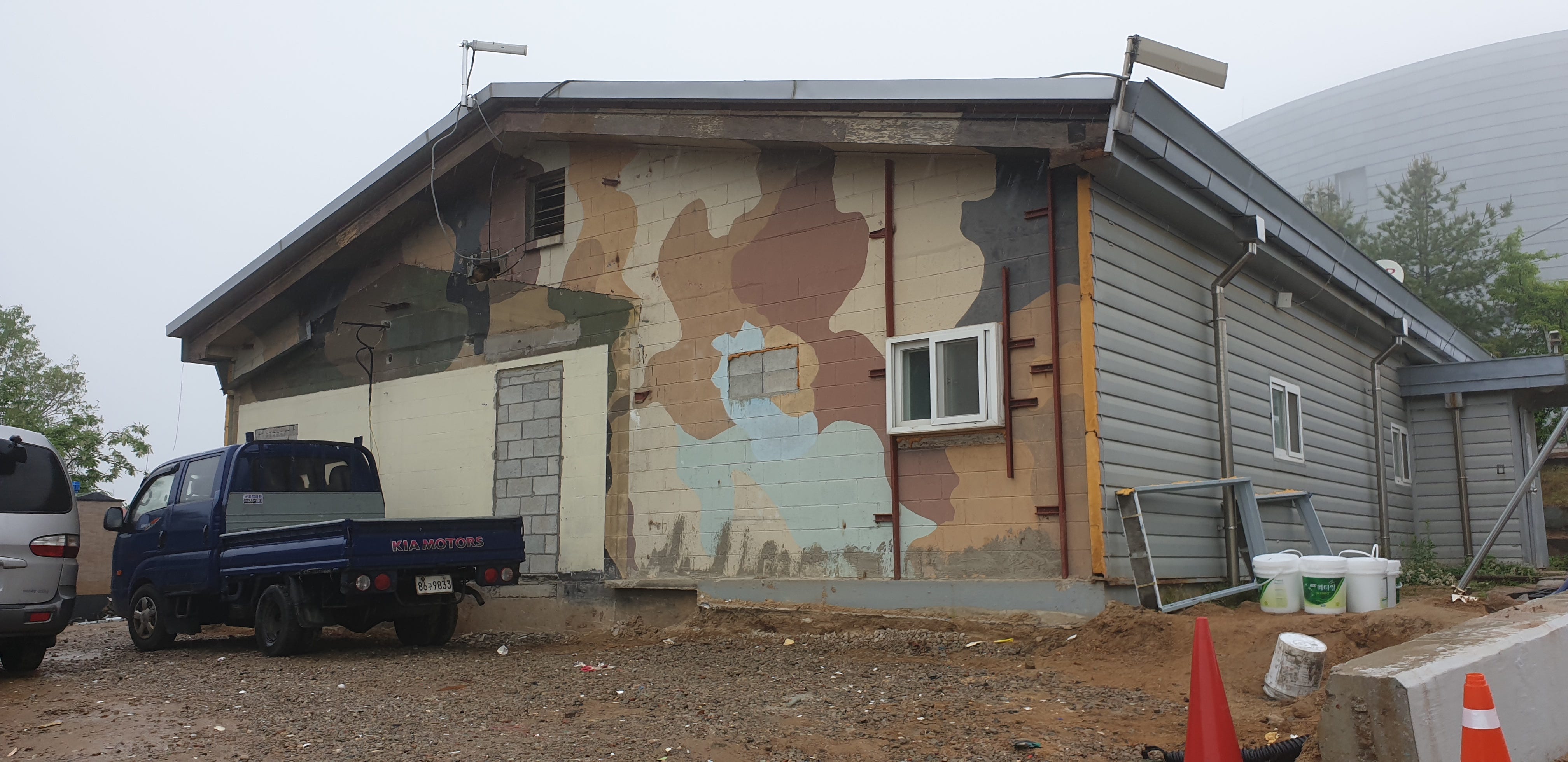
The small number of residents of the DMZ live under strict conditions, with rigorous curfews and headcounts on a daily basis, but most residents have a higher income than the average South Korean – a function of the government incentives offered in exchange for their predicament: huge plots of land for farming, no taxes to pay, and (ironically) an exemption from compulsory military service.
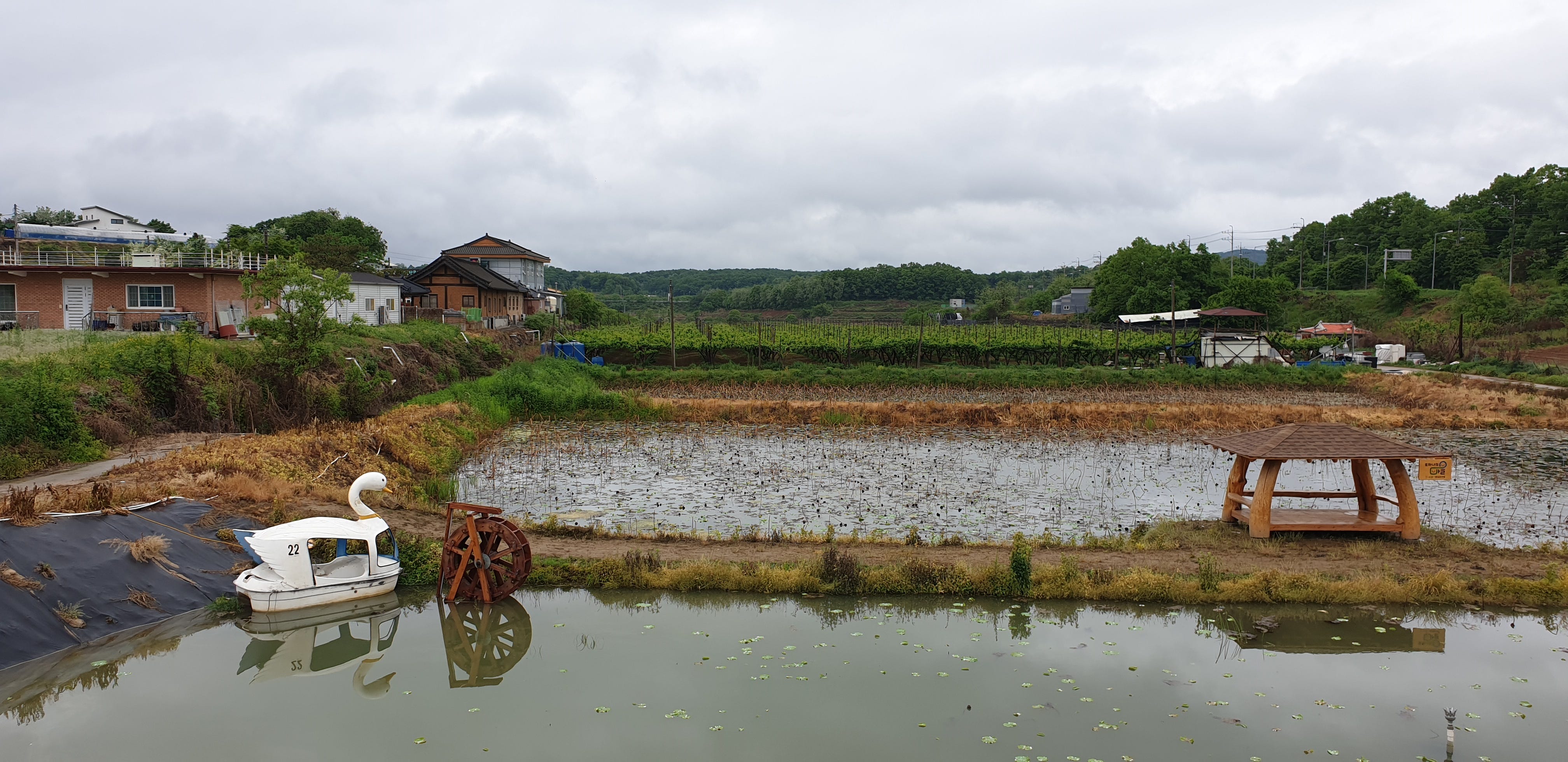
Just down the dust road from the souvenir shop, stranded in the middle of so many half-ploughed fields, I find two shallow ponds, both rectangular in shape. They’re difficult to place – untended rice fields perhaps? – but any logical explanation I can come up with is exploded by the abandoned swan pedalo bobbing away in a far corner.
This tired white swan has a number 22 painted on its side – two little ducks, quack quack quack – and I wonder where in the world its 21 (or more) siblings reside. Wherever they float, surely they are more in demand than the lone swan pedalo of the DMZ?
XXX
Back on my first day in Seoul I took a bus to a meeting on the other side of town. My colleagues are always telling me not to take public transport in places I don’t know – take a taxi, claim it back on expenses – and I always ignore them.
When I board, the bus driver is horrified by my pronunciation, but he understands enough to reply – in English – that a ticket there will cost me 9,000 Won. I can’t do the sums quick enough in my head, but that sounds like a lot for a single shortish journey. Too late now. I hand over a 10,000 Won note (£6, give or take) and am greeted with that universal look of disgust which I understand all bus drivers are taught on their first day of training.
As he dispenses endless coins into the metal tray, clunk clunk clunk clunk, and the other passengers roll their eyes, I piece together what’s happened – the bus driver told me nine thousand Won in English, but he meant nine hundred Won. Me handing over this large note is as welcome as spitting in a stranger’s face, and although the minor language mistake is his, the real faux pas is all mine. The outsider’s habitual crime of not knowing enough about how things work round here and expecting the locals to make it all frictionless for your benefit.
I do feel better when a group of young Americans get on a few stops later. They’re bouncy and boisterous, peach-skinned energetic boys with neon caps and neon backpacks and neon teeth. I assume they’re all schoolkids, maybe 14 or 15, until I hear them talking about their drills. South Koreans are more enthusiastic about US foreign policy than almost anyone else worldwide (Israel being the obvious exception), and of course these bus passengers are not boys, they’re men, trained killers in fact, dispatched thousands of miles from home and armed with the deadliest weapons in human history, here (so the story goes) to help protect the people of the South from their aggressive neighbour to the North.
I’m the only other westerner on the bus so it only takes a moment or two for the inevitable to happen:
- Where you from?
- London, I lie.
- Cool. Where you headed?
I explain where my meeting is and they share where they’re going too – I’ve only been in Seoul for a few hours, but I know it’s in the opposite direction to where this bus is headed.
It takes me a few minutes to convince them. They crowd around me in the middle of the bus and we compare maps on our various devices. We watch as so many blue dots (representing us? the bus? our phones?) slide along the same route in parallel and we jab fingers at grey blocks which slide up and down the screens. Eventually they accept they’ve made a mistake and hurry in garrison to the front of the bus to jump off and try again.
- Thanks dude, a grinning boy shouts back at me. How long have you lived here?
- Oh, I just got here, I say.
- That’s cool. Us too. Six months next week.
TO BE CONTINUED
